
As the digital landscape shifts from traditional search queries toward generative AI interactions, the methods we use to communicate with crawlers are undergoing a fundamental transformation. For years, the robots.txt file and XML sitemaps have been the gold standard for guiding search engines like Google and Bing. However, with the rise of Large Language Models (LLMs) and "Answer Engines," a new protocol has emerged: llms.txt.
This seemingly simple Markdown file is poised to redefine how professional website development and design services are executed. By providing a curated roadmap specifically designed for AI ingestion, llms.txt ensures that your brand’s most critical information is accurately captured and summarized by the bots that power ChatGPT, Claude, and Google Gemini.
The Evolution of Discovery: From Indexing to Inference
To understand the importance of llms.txt, one must first distinguish between traditional indexing and AI inference. Traditional SEO focuses on helping search engines index pages so they can appear in a list of results. Conversely, AI agents "crawl" your site to understand context and provide direct answers to user prompts: a process often referred to as Answer Engine Optimization (AEO).
While a standard sitemap provides a comprehensive list of every URL on your domain, it often includes "noise": tag pages, old blog archives, or utility pages that provide little value to an AI trying to summarize your business. The llms.txt proposal introduces a way to point these models directly toward "high-signal" content.

1. Streamlining Information Architecture for Machine Readability
The introduction of llms.txt forces a renewed focus on Information Architecture (IA). When we approach website design services, we prioritize a structure that is intuitive for humans. Now, we must also ensure it is legible for machines.
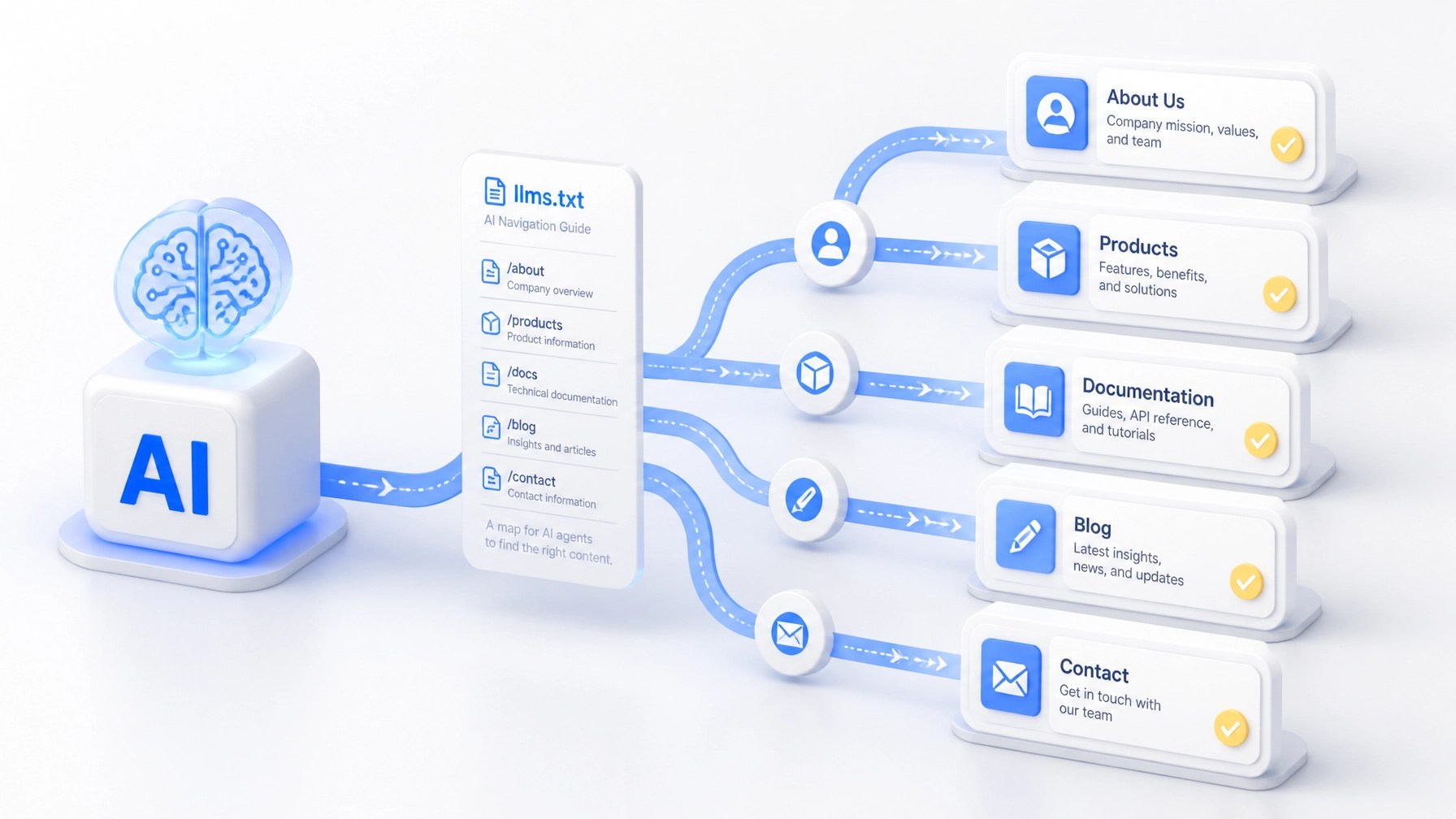
An effective llms.txt file acts as a high-level table of contents. It typically includes:
- Canonical Documentation: Direct links to your most accurate product or service guides.
- Policy Summaries: Clear paths to terms of service and privacy policies.
- Markdown Exports: Links to versions of your pages that are stripped of heavy JavaScript and CSS, making them easier for LLMs to parse.
By integrating this into your design phase, you mitigate the risk of AI agents hallucinating or retrieving outdated information from your site.
2. Enhancing Answer Engine Optimization (AEO)
If your website isn't optimized for how AI models process data, you risk being left out of the conversation entirely. Search engines are increasingly using AI to generate "Overviews" at the top of search results. In this environment, visibility is no longer just about rank; it is about attribution.
By leveraging an llms.txt file, you proactively guide the AI to the specific pages you want it to cite. This strategy is particularly effective for lead generation for businesses, as it ensures that the "answer" provided by a chatbot includes your most persuasive and up-to-date value propositions.
3. Improving Website Performance and Crawl Efficiency
Large Language Models are resource-intensive when they crawl the web. Standard HTML pages filled with interactive elements, animations, and complex scripts can be difficult for AI bots to "read" efficiently.
One of the core benefits of the llms.txt standard is the ability to link to machine-friendly versions of your content. For example, providing a link to a clean Markdown (.md) version of a long-form whitepaper allows the AI to ingest the data instantly without wading through the code required to render a visual webpage. This not only improves the accuracy of the AI's output but can also reduce the crawl load on your server.
4. Future-Proofing Your Brand Identity
We have previously discussed how to avoid common SEO mistakes, but the "mistake" of the future will be failing to account for AI-driven discovery. As more users turn to AI assistants to research companies, your llms.txt file becomes a vital component of your brand's digital identity.
Think of it as a professional executive summary for the robots. It allows you to define exactly what your company does, who it serves, and what its core values are, ensuring that the AI’s "opinion" of your brand is based on facts you have provided.

How to Implement llms.txt: A Proactive Checklist
While the protocol is still an emerging standard, early adoption can give you a competitive edge. Here is how you can begin the implementation process:
- Audit Your Content: Identify which 10–20 pages on your site provide the most "signal" (e.g., your homepage, service pages, and key case studies).
- Create the Markdown File: Place a file named
llms.txtin your site's root directory (e.g.,yourdomain.com/llms.txt). - Use Structured Headings: Use Markdown H2 tags to categorize your links (e.g.,
## Core Services,## Support & Documentation). - Provide Descriptions: Add brief, one-sentence descriptions for each link to provide context to the LLM.
- Test for Accessibility: Ensure that the links provided in the file are not blocked by
robots.txtand are easily accessible to crawlers.
For a deeper dive into the technical specifications, you can refer to resources like Semrush’s guide on llms.txt or Mintlify’s documentation.
Conclusion: The Strategic Path Forward
The digital marketing industry is at a crossroads. While traditional search visibility remains vital, the emergence of AI-first browsing requires a more sophisticated, proactive approach to content delivery.
At Integrated Mobile Marketing, we believe that website design is no longer just about what the user sees: it is about how the entire digital ecosystem interacts with your data. Implementing an llms.txt file is a sophisticated way to demonstrate that your business is forward-thinking and ready for the AI era. By refining your information architecture and embracing machine-friendly standards, you can ensure that your brand remains authoritative, relevant, and highly visible in every corner of the web.